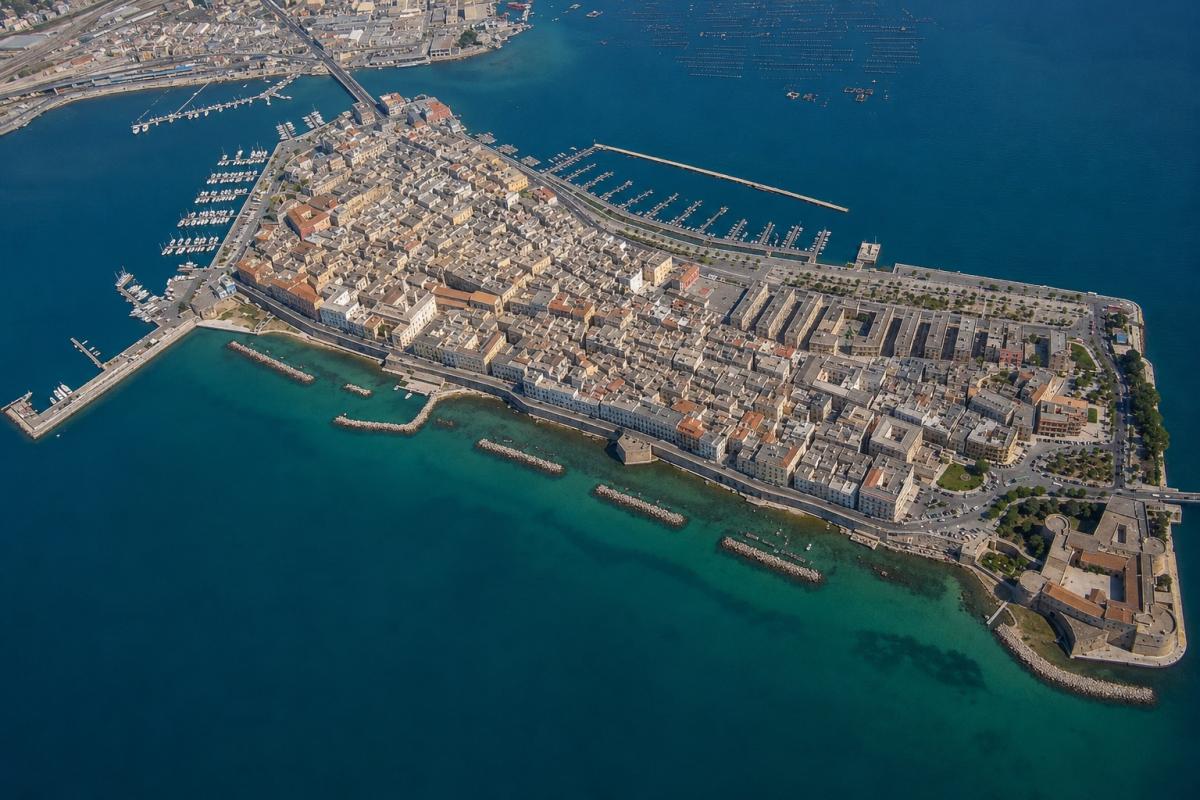
The Cathedral Basilica of San Cataldo, in the heart of the Old City of Taranto, is the mother church of the metropolitan Archdiocese and the oldest cathedral in Puglia. A national monument and minor basilica, it is still a place of Catholic worship: it hosts liturgical celebrations, devotion to the city's patron saint, San Cataldo, and historical and artistic visits. Originally, the area was associated with the cult of Mary Magdalene; the cathedral was later dedicated to San Cataldo, an Irish bishop venerated as the patron saint of Taranto....Read more
The Cathedral Basilica of San Cataldo, in the heart of the Old City of Taranto, is the mother church of the metropolitan Archdiocese and the oldest cathedral in Puglia. A national monument and minor basilica, it is still a place of Catholic worship: it hosts liturgical celebrations, devotion to the city's patron saint, San Cataldo, and historical and artistic visits. Originally, the area was associated with the cult of Mary Magdalene; the cathedral was later dedicated to San Cataldo, an Irish bishop venerated as the patron saint of Taranto. The complex preserves traces of a long sacred continuity: a previous structure could date back to the early Christian era, while the Byzantine reconstruction at the end of the 10th century was promoted within the framework of the urban renewal desired by the Emperor Nikephoros II Phokas. Between the 11th and 12th centuries, the building acquired a Romanesque basilica plan, incorporating parts of the older structure; in the following centuries, it underwent various transformations and restorations. The exterior features a sober Romanesque structure, recognizable especially on the sides and the lantern, contrasted by the scenic late Baroque facade designed by Mauro Manieri in 1713. The interior is divided into three naves, marked by columns and capitals of reused Greco-Roman style, a testimony to the ancient history of the city. The central nave stands out for its wooden ceiling with golden coffered panels, known as the "golden ceiling," with statues of the Assumption and San Cataldo. In the floor, fragments of the medieval mosaic created between 1163 and 1165 by the mosaicist Petroius can still be seen, depicting scenes from the Flight of Alexander the Great. Near the high altar is the 17th-century porphyry ciborium, while the wooden choir completes the presbytery. Of particular importance is the Baroque Chapel of San Cataldo, elliptical in shape, rich in marbles, mother-of-pearl, vitreous pastes, and lapis lazuli. It houses the relics of the saint, rediscovered in 1071, and his silver statue; the frescoes by Paolo De Matteis depict episodes of his glory and miracles, while various sculptures are attributed to Giuseppe Sammartino. The Chapel of the Blessed Sacrament houses seventeenth-century paintings by Giovanni Molinari. Underneath the presbytery, there is a Byzantine crypt, with spoils columns, cross vaults, and frescoes from the 13th and 14th centuries. A medieval sarcophagus and burials related to the ecclesiastical and civil history of Taranto can also be found here. The cathedral is therefore an exceptional palimpsest of Byzantine, Romanesque, and Baroque art, as well as one of the main religious and cultural symbols of the city.
Read less