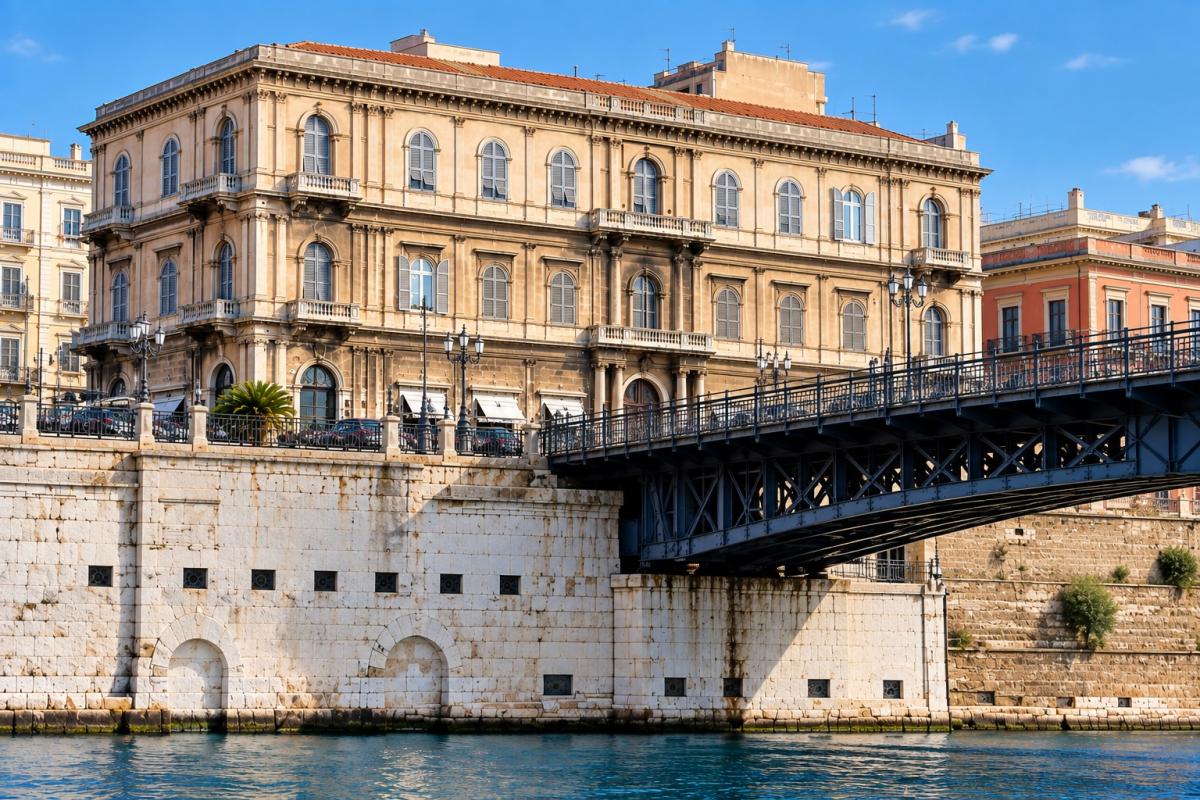
The Swing Bridge of San Francesco di Paola is one of the most recognizable symbols of Taranto, connecting the Island of Borgo Antico with the peninsula of Borgo Nuovo, crossing the Navigable Canal that connects Mar Grande and Mar Piccolo. It is a swivel metal bridge, about 89 meters long and just over 9 meters wide, consisting of two independent semi-bridges. By rotating around their respective pivots, it allows passage for ships heading towards the Maritime Military Arsenal located in Mar Piccolo. The management of the bridge openings and maintenance is entrusted to the Italian Navy....Read more
The Swing Bridge of San Francesco di Paola is one of the most recognizable symbols of Taranto, connecting the Island of Borgo Antico with the peninsula of Borgo Nuovo, crossing the Navigable Canal that connects Mar Grande and Mar Piccolo. It is a swivel metal bridge, about 89 meters long and just over 9 meters wide, consisting of two independent semi-bridges. By rotating around their respective pivots, it allows passage for ships heading towards the Maritime Military Arsenal located in Mar Piccolo. The management of the bridge openings and maintenance is entrusted to the Italian Navy. Its function is both urban, as it is a fundamental road link between the two parts of the city, and naval, as it allows the passage of military units and large vessels in the canal. The opening, carried out through electromechanical mechanisms, is a particularly evocative and identity-building event: it temporarily interrupts the city's continuity and attracts citizens and visitors along the canal banks. The area has a remarkable historical and archaeological stratification. The first excavations of the canal date back to around 1481, when the separation of the ancient isthmus contributed to the defense of the Aragonese Castle; the passage was then ensured by a stone bridge with three arches called Ponte di Porta Lecce. In the second half of the 19th century, the canal was expanded to allow the establishment of the Arsenal and the navigation of larger ships. The first modern swing bridge was inaugurated on May 22, 1887, designed by engineer Giuseppe Messina and built by the company Alfredo Cottrau. It was dedicated to Saint Francis of Paola, protector of seafarers, and operated by an ingenious hydraulic system connected to a cistern near the Aragonese Castle. The current structure, similar in shape but more modern, replaced the 19th-century one between 1957 and 1958; it was inaugurated on March 10, 1958, by the President of the Italian Republic Giovanni Gronchi. In addition to its technical value, the bridge represents the link between ancient and modern Taranto, between historical memory, civilian life, and maritime vocation. Its fame is also attested by the verses of Gabriele D'Annunzio in "Lauds" and by appearances in movies, including Roberto Rossellini's "La nave bianca."
Read less